malloc 的微浅理解
这段时间在学习数据结构。对数据结构中的 malloc 总是感到困惑,这几天查了资料,算是查清楚了 malloc 的用法,特此记录 在数据结构中,对结构体最开始分配空间的步骤是(以线性表为例):
#include <stdio.h>#include <stdlib.h>
#define MaxSize 100typedef int ElemType;
typedef struct {  ElemType data[MaxSize];  int length;} SqList;
void CreateList(SqList *&L, ElemType a[], int n) {  if (n < 0 || n > MaxSize) return;  L = (SqList *)malloc(sizeof(SqList));  if (L == NULL) return;  for (int i = 0; i < n; i++)    L->data[i] = a[i];  L->length = n;}
在这段算法中,比较难理解的是这两行代码
SqList *&L;//和L = (SqList *)malloc(sizeof(SqList));前者是对指针本身的引用,让函数能修改外面那个指针变量,而不只是它指向的内容。后者是向堆申请 sizeof(SqList) 字节的内存,把首地址赋给 L——这时候 L 才第一次指向某个对象。
对于SqList *&L,先要分清楚表达式和声明。在表达式里,* 放在指针前面表示解引用,也就是取出指针指向的值,例如 int x = *ptr; 就是把 ptr 指向的整数值赋给 x。而 SqList *&L 是声明,这里的 * 只是声明符的一部分,不是解引用动作,& 也不是取地址。
& 运算符:& 运算符用于取地址操作。当 & 用于变量前面时,它返回该变量的地址。例如,int x = 10; int *ptr = &x; 将变量 x 的地址赋给指针 ptr。
*&:* 表示指针,& 表示引用,合起来就是“指针的引用”。这是 C++ 的语法:纯 C 没有引用,想达到同样的效果只能传二级指针,写成 SqList **L,调用方写 CreateList(&L, a, n)。
因此,SqList *&L 声明的是一个 SqList * 变量的引用:L 是外部那个指针的别名,指针本身指向 SqList 对象。
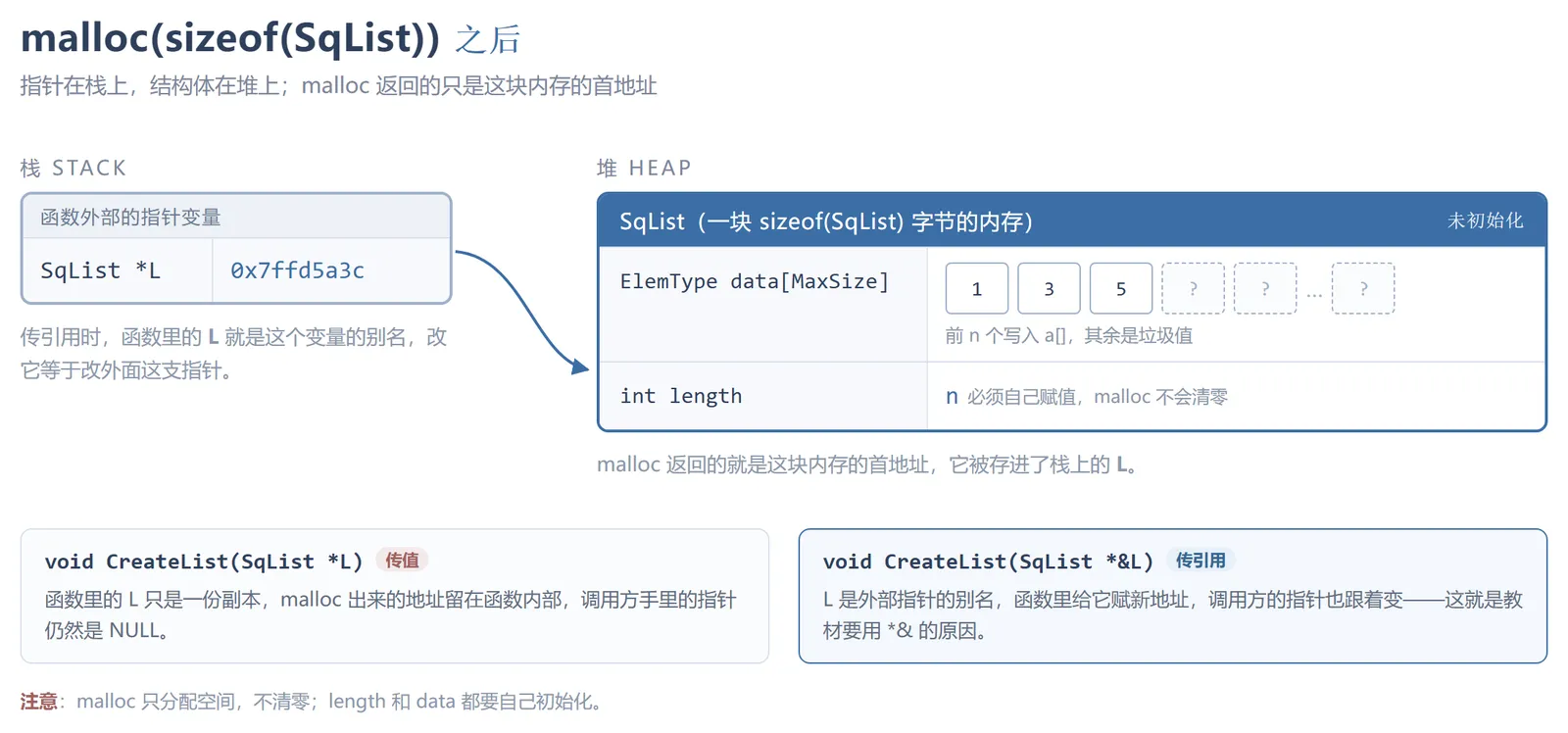
我们再来讲讲 malloc。malloc 全称 memory allocation,在 cppreference 中有写到 malloc 的功能。
Allocates
sizebytes of uninitialized storage.
分配size字节的未初始化存储。If allocation succeeds, returns a pointer that is suitably aligned for any object type with fundamental alignment.
如果分配成功,则返回一个指针,该指针适合任何具有基本对齐方式的对象类型。If
sizeis zero, the behavior ofmallocis implementation-defined. For example, a null pointer may be returned. Alternatively, a non-null pointer may be returned; but such a pointer should not be dereferenced, and should be passed to free to avoid memory leaks.
如果size为零,则malloc的行为是实现定义的。例如,可以返回空指针。或者,可以返回非空指针;但这样的指针不应该被取消引用,并且应该传递给 free 以避免内存泄漏。
以下是 malloc() 函数的声明。
void* malloc(size_t size);其中,size_t是一个无符号整数类型,通常用于表示内存块的大小。
在不同的平台上,size_t 的大小可能会有所不同,但它通常被设计为足以容纳系统中最大可能的对象大小。
size_tcan store the maximum size of a theoretically possible object of any type (including array).
void* 是一个指针类型,表示指向未知类型的指针。这种类型的指针可以指向任何类型的数据,但不能直接对其进行解引用操作。
所以我们需要将其转化,因此可以有
int* intPtr = (int*)malloc(sizeof(int));或者说,在 C 里可以利用隐式转换,省掉强转
int* intPtr = malloc(sizeof(int));注意这只在 C 里成立。C++ 不允许 void* 隐式转成 int*,必须写成 int* intPtr = (int*)malloc(sizeof(int));,否则直接编译报错。
此刻,一个内存空间就创立好了,那么,发生了什么事情?
当执行 int* intPtr = malloc(sizeof(int)); 这行代码时,发生了以下几件事情:
malloc分配内存:malloc(sizeof(int))这部分是一个函数调用,它调用了malloc函数来分配一块内存空间,大小为sizeof(int)字节,也就是一个整数大小的内存块。sizeof()是一个运算符,用于计算指定类型的大小。返回指针:
malloc函数返回一个指向新分配的内存块起始地址的指针。这个指针的类型是void*,即指向未知类型的指针,要转成具体类型才能用(C 可以省略,C++ 不行)。类型转换:在赋值语句
int* intPtr = ...中,void*类型的指针被隐式地转换为int*类型的指针(C 语言;C++ 要显式强转)。这是因为int*类型的指针可以指向整数类型的数据,而malloc返回的指针指向的是刚分配的内存块,大小为一个整数的大小。赋值给指针变量:分配的内存块的起始地址被赋值给了
intPtr指针变量,使得intPtr指向了这块新分配的内存空间。
因此,int* intPtr = malloc(sizeof(int)); 这行代码的作用是分配一块大小为一个整数大小的内存空间,并将其起始地址存储在 intPtr 指针变量中,以便后续使用。
还有一点容易被忽略:malloc 拿到的是未初始化的内存。它只是把空间留出来,里面还留着上一任使用者写下的垃圾值,所以结构体分配完之后要自己赋初值(比如 L->length = 0;),不能假设它是干净的。
当然,这个数字还可以通过 n 来拓展。
cppreference.com 也写出了关于它的用法和格式。
#include <stdio.h>#include <stdlib.h>
int main(void){    int *p1 = malloc(4*sizeof(int));    // allocates enough for an array of 4 int(为 4 个 int 的数组分配足够的空间)
    int *p2 = malloc(sizeof(int[4]));//same, naming the type directly(一样,直接命名类型)
    int *p3 = malloc(4*sizeof *p3);//same, without repeating the type name(相同,不重复类型名称)
    if(p1) {        for(int n=0; n<4; ++n) // populate the array            p1[n] = n*n;        for(int n=0; n<4; ++n) // print it back out            printf("p1[%d] == %d\n", n, p1[n]);    }
    free(p1);    free(p2);    free(p3);}
如有错误,还请指出,愿我们共同成长。
(2026-11-11 修订:示例代码补上了下标初始化、越界与分配失败检查;区分了 *& 是 C++ 语法,以及 void* 转换在 C 与 C++ 中的差异。)
参考资料:

评论
评论即将加载...